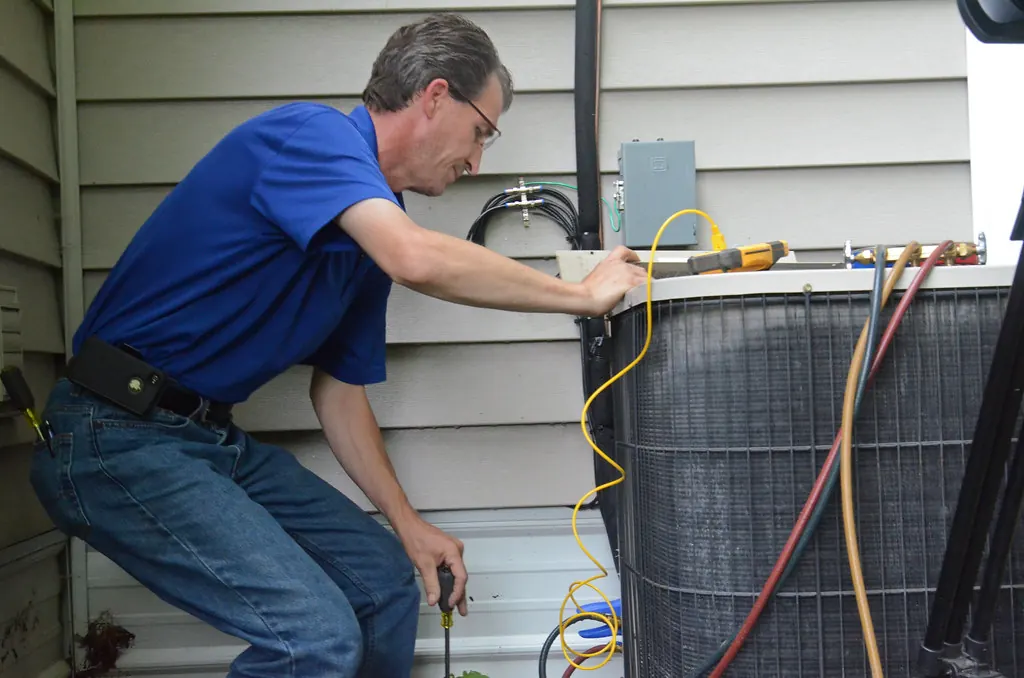
By Chula Vista HVAC Pros · 2026-11-17 · Chula Vista, CA
Why does an AC freeze up in Chula Vista? The airflow and refrigerant causes, what to do when you see ice, and how to stop it happening again.
Ice on an air conditioner is a strange sight in a San Diego County summer — frost on the copper lines, ice around the indoor unit, a system that blows weaker and weaker air until it stops cooling altogether. It looks like a refrigeration problem, and in a sense it is. But the cause is almost always one of two things: the airflow has dropped, or the refrigerant is low. Both make the evaporator coil too cold, and a coil that is too cold freezes the moisture in the air passing over it.
The evaporator coil is supposed to run cold — that is how it cools the air. But it is supposed to run just above freezing, with a steady stream of warm air passing over it to keep it there. When the airflow drops, the coil has less warm air to absorb heat from, and its temperature falls below freezing. Moisture in the air condenses on the fins and freezes. The ice insulates the coil further, airflow drops further, and more ice forms — a cycle that ends with a coil encased in ice and a system that cannot cool at all. The same thing happens when the refrigerant is low: with less refrigerant in the coil, the pressure drops, the temperature drops, and the coil freezes from the inside out. Both causes produce the same visible result — ice — but they need different fixes.
A filter that has not been changed restricts the air the blower can pull through the system. Less air across the coil means a colder coil, and a colder coil means ice. This is the most common cause of a frozen coil in Chula Vista, and it is also the most preventable. The dry months load filters with dust quickly, and a home with pets loads them faster still. The filter is the cheapest part of the system and the most common cause of a preventable breakdown — and the fix is a filter change, not a repair. If the coil has frozen, turn the system off, set the fan to On so air keeps moving across the coil, and let it thaw completely before the system is restarted. Running a frozen system risks liquid refrigerant reaching the compressor, which is the most expensive part to replace.
When the refrigerant charge drops, the pressure in the evaporator coil drops with it, and the coil temperature falls below freezing. The system cools weakly at first — the house feels a little warmer in the afternoon — and then the coil freezes and cooling stops. The important thing about a refrigerant freeze is that the refrigerant went somewhere: a system does not use up refrigerant, it leaks it. A recharge without finding the leak is a temporary fix that ends with the same problem a few months later, usually at the hottest point of the season. The leak has to be located — at a joint, a valve, or the coil itself — and repaired before the system is recharged.
A failing blower motor moves less air, and the coil freezes for the same reason a clogged filter freezes it: not enough warm air passing over the fins. A duct problem — a crushed section, a disconnected run, a return duct pulling in too little air — has the same effect. And a thermostat fault can freeze a coil too: a system that runs constantly without cycling off, because the thermostat never registers that the house is cool enough, will eventually freeze its own coil. These are less common than the filter and the refrigerant, but they are all checked during a diagnostic visit, because a coil that froze once will freeze again if the cause is not found.
Turn the system off at the thermostat and set the fan to On. The moving air thaws the coil faster than still air, and the system should stay off until the ice is completely gone — which can take several hours. Change the filter while you wait, because a dirty filter is the most likely cause and it is also the simplest fix. Do not chip the ice off the coil, and do not run the system in the hope that it thaws while operating — it does not, and the compressor pays for it. Once the coil has thawed and the filter is changed, the system can be restarted and watched: if it cools normally, the filter was the cause. If it freezes again, the cause is refrigerant or airflow, and the system needs a diagnostic visit.
When a frozen coil turns out to be a refrigerant problem rather than an airflow problem, the next step is finding the leak — and the leak is found, not guessed at. The technician starts with the common points: the flare fittings on a mini split, the valve cores on the service ports, the joints where the refrigerant lines meet the indoor and outdoor units. An electronic leak detector — a sensor that sniffs for refrigerant in the air around a joint — narrows the search to a small area. A dye test, where a fluorescent dye is added to the refrigerant and the system is inspected with an ultraviolet light, shows the leak as a glowing trace at the exact point. A pressure test, where the system is pressurized with nitrogen and watched for a drop, confirms whether the leak is still there after a repair. Each method has its place, and the choice depends on the system and the suspected location. What matters is that the leak is found before the system is recharged — because a recharge without a leak repair is a temporary fix that ends with the same problem a few months later, usually at the hottest point of the season. The coil that froze in July was leaking in April, and the leak that is found in April is the freeze that never happens in July.
A frozen coil is a problem that can usually be prevented, and the prevention is a set of habits rather than a repair. The first is the filter: changed on the schedule the home needs, checked monthly through the summer, and the right size and density for the system — a filter that does not fit leaves gaps for dust to bypass it, and a filter so dense it chokes an older blower causes the same problem as a dirty one. The second is the coil itself: cleaned during the yearly tune-up, so the fins can transfer heat properly and the coil temperature stays where it should. The third is the refrigerant: checked during the tune-up, so a slow leak is found before it drops the charge far enough to freeze the coil. The fourth is the airflow: vents open, return grilles unblocked, the blower tested — because the coil freezes when it does not get enough warm air, and anything that restricts the air can start the cycle. And the fifth is attention: the first sign of a freeze is not ice, it is weak cooling — the system runs longer, the air feels less cold, the far rooms stay warm. Noticing that change in May, and having the system checked, is the prevention. A coil that froze once will freeze again if the cause is not fixed — but a coil that is maintained, with a clean filter, a clean coil, a correct charge, and open airflow, rarely freezes at all. The habits are small. The freeze they prevent is not.
The thaw-and-watch test is the simplest diagnostic a homeowner can do after a freeze. Turn the system off, set the fan to On, let the coil thaw completely, change the filter, and restart the system. Then watch it for a full afternoon: does it cool normally, does the air feel cold at every vent, does it cycle normally rather than running constantly? If it does, the filter was the cause, and the system is sound. If it freezes again, the cause is refrigerant or airflow, and the system needs a diagnostic visit — temperature readings, refrigerant pressures, blower testing, and a check of the ducts. The test costs nothing, takes an afternoon, and separates the simple fix from the fault that needs a technician. A coil that froze once and never freezes again was a filter problem. A coil that freezes twice has a problem that a filter cannot fix, and the second freeze is the one that should not be ignored — because every freeze puts the compressor at risk, and a compressor run to failure is the most expensive repair in the system.

How often does an AC need servicing in Chula Vista? The yearly schedule, what a tune-up covers, and why spring is the time to book.
Read more →
Repair or replace your AC in Chula Vista? The age, cost, and condition factors that decide it — and the questions to ask before you choose.
Read more →
How long does an AC last in San Diego County? The typical lifespan, what shortens it, and the habits that add years to your system.
Read more →Ice on the refrigerant lines means the evaporator coil has frozen. The usual causes are a clogged filter restricting airflow, or low refrigerant from a leak. Turn the system off and let it thaw.
Yes. Turn it off at the thermostat and set the fan to On so air keeps moving across the coil and it thaws faster. Running a frozen system risks liquid refrigerant reaching the compressor.
Yes. A clogged filter restricts airflow, the coil gets too cold, and ice forms. It is the most common cause of a frozen coil and the most preventable.
Several hours, depending on how much ice has formed. The fan set to On speeds the thaw. Do not restart the system until the ice is completely gone.
It will if the cause is not fixed. A dirty filter is fixed by changing it. Low refrigerant needs a leak repair and a recharge. A failing blower or a duct problem needs a diagnostic visit.
Describe the symptoms — what the system is doing, which rooms are affected, and whether the outdoor unit is running — and get a clear next step.
For AC repair, furnace repair, heat pump and mini split service, and maintenance across Chula Vista and San Diego County, reach out through the contact page.