By Chula Vista HVAC Pros · 2026-11-17 · Chula Vista, CA
Repair or replace your AC in Chula Vista? The age, cost, and condition factors that decide it — and the questions to ask before you choose.
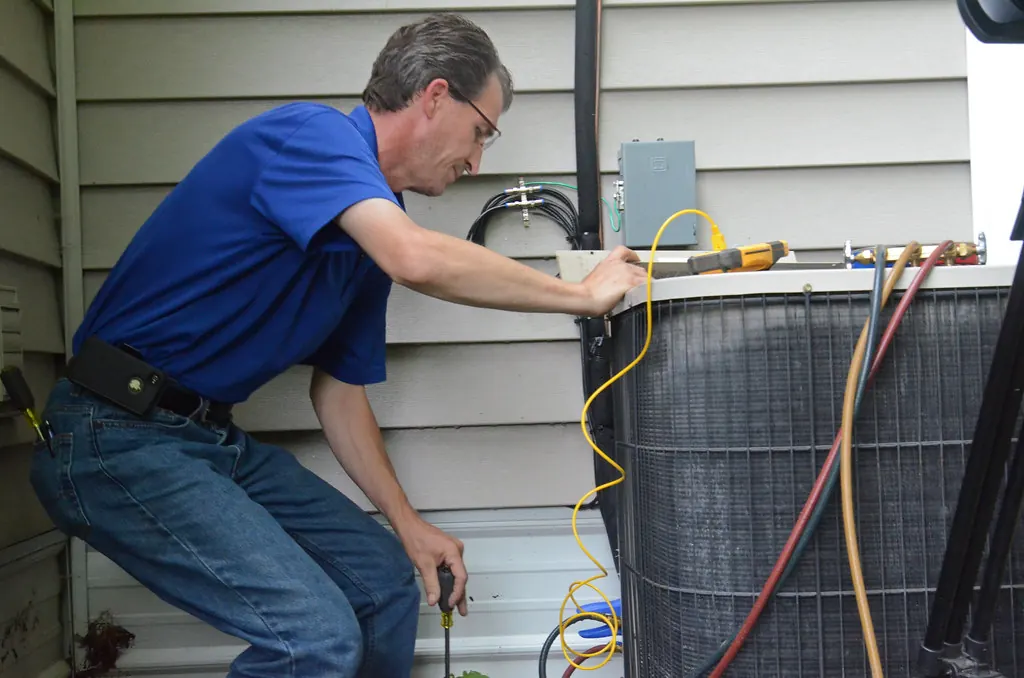
Every air conditioner reaches a point where the next repair is not the smartest money. The system still runs, but it runs longer, cools less, and asks for attention every season. The question is not whether to repair or replace in the abstract — it is whether the money spent on this repair buys enough remaining life to be worth it. That question has a concrete answer, and it comes from four facts: the age of the system, the nature of the failure, the condition of the rest of the equipment, and the condition of the ducts.
The first question is what actually failed. A capacitor, a contactor, a fan motor, or a thermostat is a single-component failure, and it is a repair — even on a system that is fifteen years old. These parts are designed to be replaced, and replacing one of them restores the system fully. A compressor failure is different: the compressor is the heart of the system and the most expensive single component, and replacing it on an older system rarely makes sense against the cost of a new system. A refrigerant leak is in the middle: a leak at a single joint can be repaired, but a coil that leaks from several points is telling you the metal is failing throughout, and the repair will not hold. The failure decides the shape of the decision; the age decides the numbers.
A well-maintained central system typically lasts around fifteen years, sometimes longer on the cooler west side of Chula Vista and sometimes shorter in the harder-working inland neighborhoods. But age alone is a poor reason to replace. A fifteen-year-old system that has been serviced every year, has a clean coil, and has never needed a major repair is a different machine from a fifteen-year-old system that has needed a compressor, a coil, and a fan motor in the last three years. The repair history is the better guide: a system that needs major work every season has entered the phase where the repairs cost more than the remaining life they buy. A system with a clean history and a single failure has not.
This is the part of the decision most homeowners miss. A new system connected to leaking ducts wastes its efficiency into the attic, and the house cools no better than it did with the old system. Before any replacement, the ducts should be inspected — and if they leak, the replacement should include sealing them, or the new system's advantage is lost on day one. The same applies to sizing: the old system was sized for the house as it was when it was installed, before the addition, before the new windows, before the insulation upgrade. A replacement is the moment to redo the load calculation and size the new system for the house as it stands today. A replacement that simply swaps in a unit of the same size repeats the old system's mistakes with new equipment.
Older systems run on refrigerants that are being phased out, and servicing those systems gets harder and more expensive as supply tightens. A system that needs a refrigerant recharge every year is not just leaking — it is leaking a refrigerant that is becoming harder to obtain. Replacement moves the home to current refrigerant and current efficiency standards, and it removes a recurring cost that will only grow. This is not the deciding factor on its own, but it is a real one, and it should be part of the comparison when the system is old enough to use a phased-out refrigerant.
Ask for three things before you decide: the load calculation for the house as it stands today, the condition of the ducts, and the repair history of the current system. With those three facts, the comparison is concrete: the cost and expected remaining life of this repair, against the cost and expected life of a new system in this house. If the repair buys several more years from a sound system, it is the right call. If the repair buys one more season from a system that will need another major component next year, it is not. The decision is not about the age on the nameplate — it is about the condition of the machine and the house it serves.
Consider a fifteen-year-old central system in an Eastlake home — two-story, around 2,400 square feet, with the original ductwork. Last summer it needed a capacitor. This spring it needed a contactor. Now the technician finds the refrigerant is low, and the leak is at the indoor coil. The compressor still runs, and the system still cools — weakly, in the afternoon, when the upstairs is warm. The repair on the table is a coil replacement and a recharge. The replacement on the table is a new matched system, sized by a fresh load calculation, with the ducts sealed. The repair buys a system that has already needed two components in two years, and whose coil is failing — the next failure is already developing, and it will be the compressor or the next leak. The replacement buys a system that will serve the house for fifteen years, on ducts that no longer leak, sized for the house as it stands today. The repair is cheaper this month. The replacement is cheaper over the next five years, because the repair will be followed by another repair, and then another. That is the pattern the decision turns on — not the age on the nameplate, and not the cost of this one repair, but the pattern of the last three years and the condition of the equipment that remains. A system that has needed a major component every season has entered the phase where the repairs cost more than the remaining life they buy, and the honest comparison is the one that counts the next three repairs, not just this one.
Before you decide between repair and replacement, there are three things the installer should show you — not tell you, show you. The first is the load calculation: the measurements of the house, the capacity it produces, and whether it differs from the size of the old system. A load calculation that was actually done has numbers in it — square footage, window areas, insulation levels — and those numbers are worth looking at, because they are the basis of the sizing decision. The second is the ducts: the condition of the accessible ductwork, what was found, and what will be sealed or corrected. A duct inspection that was actually done has findings — a disconnected joint here, a crushed section there, seals that have dried out — and those findings decide whether the new system will perform. The third is the repair history of the current system: what has been replaced, when, and what the pattern says about the remaining life. With those three things in front of you, the comparison is concrete — the cost and expected remaining life of this repair, against the cost and expected life of a new system in this house. Without them, the decision is a guess, and guesses are how households end up with a new system on leaking ducts, sized the same as the old one, with the same hot rooms they started with. Ask for the three things. A professional who has done the work will have them ready.
The question to ask yourself, when the decision is in front of you, is not whether the system is old enough to replace. It is whether the money spent on this repair buys enough remaining life to be worth it. A repair that buys several more years from a sound system is money well spent. A repair that buys one more season from a system that will need another major component next year is not. The load calculation, the duct inspection, and the repair history give you the numbers for that question, and the numbers are better than a feeling about the age on the nameplate. If the numbers say repair, repair with confidence. If they say replacement, replace with confidence — and use the replacement to correct the sizing and the ducts, so the new system does not inherit the old system's problems. Either way, the decision is made with facts, not with pressure, and a decision made with facts is one the household will not regret in July.

How often does an AC need servicing in Chula Vista? The yearly schedule, what a tune-up covers, and why spring is the time to book.
Read more →
How long does an AC last in San Diego County? The typical lifespan, what shortens it, and the habits that add years to your system.
Read more →
Why does an AC freeze up in Chula Vista? The airflow and refrigerant causes, what to do when you see ice, and how to stop it happening again
Read more →The pattern decides it: a compressor or coil failure on a system past its expected life, refrigerant leaks that keep returning, or major repairs every season. A single component failure on a younger system is a repair.
A well-maintained central system typically lasts around fifteen years, sometimes longer on the cooler west side and sometimes shorter in the harder-working inland neighborhoods. Maintenance, filter habits, and operating hours all affect the number.
The indoor coil and outdoor condenser are matched as a set, and replacing only one half usually leaves the system mismatched — lower efficiency, poor dehumidification, and a shorter life for the new part. A matched set is the standard recommendation.
It can, if the hot rooms are caused by sizing or airflow problems that the replacement corrects. But a new system on the same leaky ducts will have the same hot rooms. The duct inspection and airflow balancing are what fix uneven cooling.
The size the load calculation produces for the house as it stands today — not the size of the old unit, and not a guess from square footage. Additions, new windows, and insulation changes can all change the answer.
Describe the symptoms — what the system is doing, which rooms are affected, and whether the outdoor unit is running — and get a clear next step.
For AC repair, furnace repair, heat pump and mini split service, and maintenance across Chula Vista and San Diego County, reach out through the contact page.