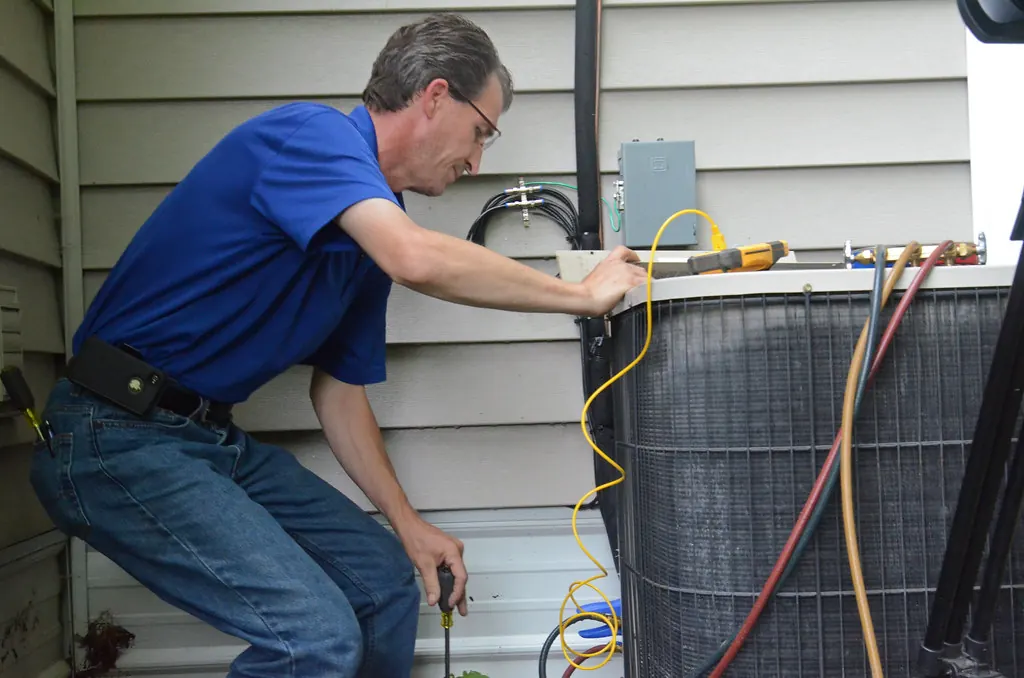
By Chula Vista HVAC Pros · 2026-11-17 · Chula Vista, CA
Mini split vs central AC in Chula Vista — how they compare on cost, comfort, installation and the rooms they serve, and which fits your home.

Most Chula Vista homes cool with a central air conditioner: one outdoor unit, one indoor coil, and ducts carrying cooled air to every room. But a growing number of homes cool some or all of their rooms with ductless mini splits — wall-mounted heads in individual rooms, each with its own temperature. The two systems solve different problems, and the right choice depends on the house, not on which system is newer or more fashionable.
A central system cools the whole house through ducts. One thermostat controls it, one system serves every room, and the cooling is even when the ducts are sound and the system is sized correctly. It is the right choice for a home that already has good ductwork and a household that wants the whole house at one temperature. The strengths are simplicity and coverage: one system, one thermostat, every room. The weaknesses are the ducts themselves — they leak, they are expensive to fix, and they cannot give different rooms different temperatures. A central system also cools empty rooms, which wastes energy in a household that uses only part of the house during the day.
A mini split has no ducts. Each indoor head serves one room, and each head has its own controls, so different rooms can be set to different temperatures. The heads are quiet, efficient, and easy to install — a small hole through the wall for the line set, rather than a duct project through finished walls. A mini split is the right choice for a room the central system cannot serve: a garage conversion, an addition, a casita, or an upstairs bedroom that runs warm while the rest of the house is comfortable. It is also the right choice for a home without ducts at all, and for a household that wants to cool only the rooms that are occupied. The weakness is coverage: cooling a whole large house with mini splits means several heads and a multi-zone outdoor unit, which is a bigger project than a single central system.
Central AC wins on evenness when the ducts are sound: every room gets the same cooled air, and the house feels uniform. But that evenness is also its limitation — the household cannot make the bedroom cooler at night without cooling the whole house. A mini split wins on control: each room gets its own temperature, and a room that is not used is not cooled. For a household with different schedules — one person working from home in the converted garage, another sleeping in a cool bedroom — the mini split's control is the comfort advantage. For a household that uses the whole house together, the central system's evenness is the advantage. The question is not which system is more comfortable in the abstract. It is which system matches how the household lives in the house.
Installing a central system in a home that already has ducts is a replacement job: the old equipment comes out, the new equipment goes in, and the ducts are connected and sealed. Installing a central system in a home without ducts is a major project — ducts through walls, ceilings, and attics, with the disruption that implies. Installing a mini split is a smaller job: the head mounts on the wall, the line set runs through a small hole to the outdoor unit, and the room is cooling the same day. A single-zone system is usually installed in a day. A multi-zone system takes longer, but it still does not touch the walls the way a duct project does. For a single problem room, the mini split is the obvious installation choice. For a whole house, the comparison depends on whether the ducts already exist.
Both systems are efficient when they are sized correctly and maintained, and both waste energy when they are not. The difference is in how the energy is used: a central system cools the whole house, including rooms that are empty, while a mini split cools only the rooms that are occupied. In a household that spends the day in one or two rooms, the mini split uses less energy — the cooling goes where the people are. In a household that uses the whole house, the central system is comparable. Chula Vista's climate helps both: the mild winters mean a mini split's heating mode is useful all year, and the long cooling season means either system's efficiency matters for months at a time. The running cost follows the household's pattern of use more than it follows the equipment type.
Many Chula Vista homes end up with both systems, and the hybrid is often the right answer for the house. The central system cools the house — the bedrooms, the living areas, the rooms the ducts already serve — and a mini split cools the one room the central system cannot serve: the converted garage, the addition, the upstairs bedroom that runs warm while the rest of the house is comfortable. The two systems do not compete; they divide the work. The central system runs the house, and the mini split runs the room that needs its own temperature. The household gets the even cooling of the central system where it works, and the room-by-room control of the mini split where it is needed — without a duct project through finished walls, and without upsizing the central system to serve a room it was never designed for. The hybrid is also the way a household phases an investment: the mini split for the most urgent room now, and additional heads later if more rooms need them. A home that grows a mini split head at a time is a home that never has to choose between the two systems — it uses each where it is strongest, and the house is comfortable in every room, not just in the rooms the original ducts reached.
The question everyone asks about mini splits and central air is which one costs less, and the honest answer is that it depends on the house — not on the equipment. The factors that decide it are the ducts, the number of rooms, and how the household uses the home. A home with sound ductwork already in place will usually find central air the simpler installation, because the delivery system exists and only the equipment needs replacing. A home without ducts will usually find a mini split the simpler installation, because running new ducts through finished walls is the expensive part of the job, not the equipment. A single problem room — a converted garage, an addition, a hot bedroom — is almost always cheaper as a mini split, because the job is one head and one outdoor unit, completed in a day. A whole large house is a different comparison: several mini split heads and a multi-zone outdoor unit, against a central system on existing ducts. And the running cost follows the pattern of use: a household that cools only the rooms it occupies will use less energy with mini splits, while a household that uses the whole house together will use about the same with either system. The cost question cannot be answered with a figure on a website, because the figure depends on the house — its ducts, its rooms, and its routine. The assessment that precedes the choice is what produces the answer, and it is the assessment — the load calculation, the duct inspection, the room-by-room assessment — that should come before any comparison of equipment.
The room that decides it is usually the one the central system cannot serve. Walk through the house and find the room that stays warm while the rest of the house is comfortable — the converted garage, the addition, the upstairs bedroom, the casita out back. That room is the mini split's room, whatever the rest of the house uses. The rest of the house is the central system's territory, if the ducts are sound and the cooling is even. The household that has both — central for the house, mini split for the room — has the answer that fits the house as it stands, without a duct project and without upsizing the central system. And the household that has neither yet, in a home without ducts, has the mini split's answer for the whole house: one outdoor unit, several heads, each room at its own temperature. The choice is not between two systems in the abstract. It is between the rooms the house has, and the system that serves each of them. Find the room that decides it, and the choice follows.

How often does an AC need servicing in Chula Vista? The yearly schedule, what a tune-up covers, and why spring is the time to book.
Read more →
Repair or replace your AC in Chula Vista? The age, cost, and condition factors that decide it — and the questions to ask before you choose.
Read more →
How long does an AC last in San Diego County? The typical lifespan, what shortens it, and the habits that add years to your system.
Read more →It depends on the house. Central AC suits homes with sound ductwork that want even whole-home cooling. A mini split suits homes without ducts, additions, garage conversions, and households that want different temperatures in different rooms.
Yes — many homes do. The central system cools the house, and a mini split cools the one room the central system cannot serve, like a converted garage or a hot upstairs bedroom.
Most mini splits are heat pumps, so they heat in winter as well as cool in summer. In Chula Vista's mild winters they heat easily.
A multi-zone outdoor unit can serve several indoor heads, each with its own controls. The total capacity limits how many heads it can serve at once, so the sizing accounts for which rooms run together.
A single-zone mini split is usually cheaper than a central system replacement, because there is no ductwork involved. Cooling a whole large house with mini splits is a bigger project, and the comparison depends on whether the home already has ducts.
Describe the symptoms — what the system is doing, which rooms are affected, and whether the outdoor unit is running — and get a clear next step.
For AC repair, furnace repair, heat pump and mini split service, and maintenance across Chula Vista and San Diego County, reach out through the contact page.