By Chula Vista HVAC Pros · 2026-11-17 · Chula Vista, CA
Emergency AC repair or wait until morning in Chula Vista? The signs that mean call now — and the problems that can safely wait for a scheduled visit.

An air conditioner rarely fails at a convenient time. It fails on the first hot Saturday of the season, or during a heat spike when the inland neighborhoods are pushing past 90 degrees, or in the middle of the night when the compressor gives out and the house starts warming by the hour. The question in that moment is simple: is this an emergency, or can it wait until morning? The answer depends on what the system is doing, who is in the house, and how hot it is outside — and knowing the difference saves discomfort, money, and sometimes the equipment itself.
A complete cooling failure on a hot day is an emergency — especially in Chula Vista's inland neighborhoods, where the house warms fast and the indoor temperature climbs by the hour. It is more urgent still when the household includes infants, elderly family members, or anyone with a medical condition affected by heat. Water leaking into the home is an emergency for a different reason: the damage spreads quickly, and the system should be shut off and the leak addressed the same day. A breaker that trips every time the system starts is an emergency, because the fault is electrical and repeated resets risk wiring damage. And a burning smell, sparking, or scorch marks are a safety emergency — turn the system off at the thermostat and the breaker and do not restart it until it has been inspected. In all four cases, the right move is the same: make the system safe, then call.
Not every AC problem is an emergency, and knowing the difference saves everyone time. A system that cools weakly but still runs can usually wait for a scheduled visit — the house is uncomfortable, but it is not getting hotter by the hour, and the equipment is not at risk. A problem discovered in mild weather — a system that short-cycles on a cool spring day, a thermostat that misreads the room, a filter that needs changing — can wait for a scheduled visit, because the weather is forgiving and the fault is not getting worse. A noise that is new but not grinding, a system that cools some rooms but not others, and a drain that is slow but not overflowing are all scheduled-visit problems. The test is simple: is the house getting hotter, is water leaking, or is something unsafe? If none of those is true, the visit can usually be scheduled.
While waiting for a scheduled visit, there are steps that help and steps that hurt. Helpful: change the filter, open all the vents, close blinds on west-facing windows in the afternoon, use fans to move air through the house, and keep the outdoor unit clear. If the coil has frozen, turn the system off and set the fan to On so the coil thaws. Harmful: repeatedly resetting a tripped breaker to force the system to run, running a system that smells of burning electrics, and leaving a frozen system running in the hope that it thaws while operating. The system that is treated gently while it waits is the system that can be repaired; the system that is forced to run through a fault is the system that needs a larger repair.
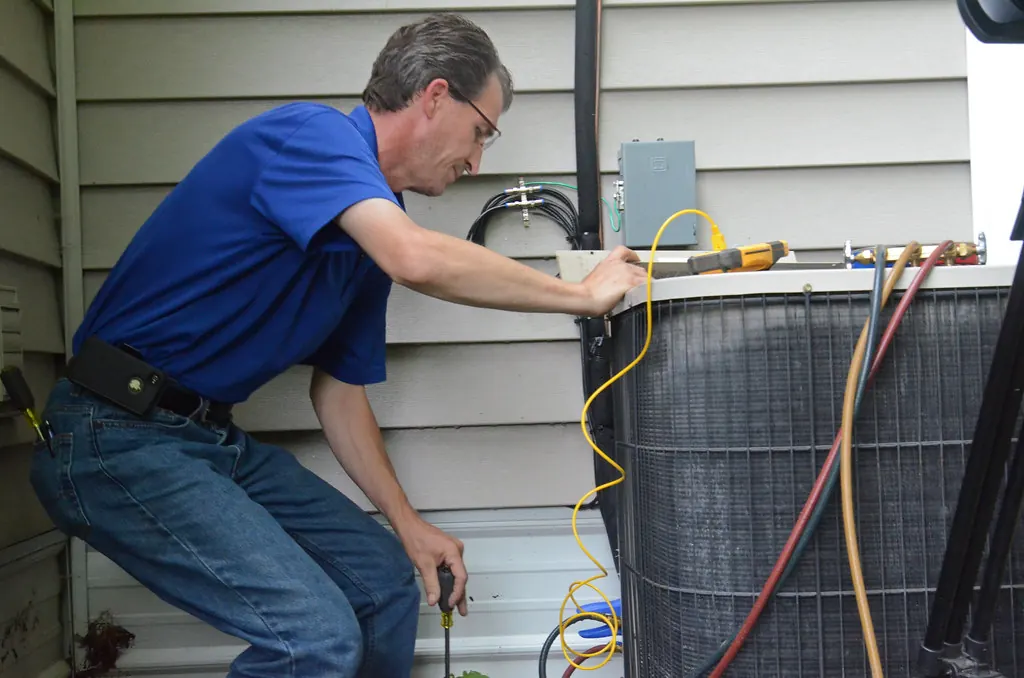
An emergency visit follows the same diagnostic sequence as a scheduled visit — symptoms, testing under load, diagnosis, repair — but it prioritizes getting cooling restored the same day, and it carries the parts that fail most often so a second trip is not needed for the common failures. Capacitors, contactors, fan motors, thermostats, and fuses are the failures that stop a system suddenly, and they can usually be fixed on the spot. Compressor failures and coil leaks are the exceptions: they need parts ordering and a follow-up visit, and an honest emergency visit says so up front. The emergency visit's job is to give you the diagnosis and the options clearly, so the decision — repair now, or plan the follow-up — is made with full information rather than in the heat of the moment.
Most emergency calls in Chula Vista cluster on the first hot days of the season, because systems that sat idle through a mild spring are asked to run hard for the first time — and the weak capacitor or the low refrigerant charge that went unnoticed all winter finally shows itself. The prevention is a spring tune-up: coils cleaned, refrigerant checked, capacitor tested, drain cleared, and a full test run before the heat arrives. The May test run — running the system for a full afternoon and checking that every room cools evenly — is the habit that finds a weak system while the weather is still forgiving. An emergency that is prevented is not just cheaper than an emergency that happens. It is also more comfortable, because the house never gets hot in the first place.
The decision between an emergency call and a scheduled visit changes when the household includes someone who is vulnerable to heat. Infants cannot regulate their body temperature the way adults can, and a hot house affects them faster. Elderly family members are more sensitive to heat, and more likely to have a medical condition that heat makes worse — heart conditions, respiratory conditions, and medications that affect the body's ability to cool itself. Anyone with a condition that heat aggravates should be treated as the deciding factor: if the house is warming and the system cannot cool it, the emergency call is the right call, even if the system might have waited for a household of healthy adults. The same applies to pets, which cannot leave a hot house on their own. The test is not whether the system is broken — it is whether the people in the house are safe while it is broken. A system that cools weakly but still runs is a scheduled visit for a household of healthy adults, and an emergency for a household with an infant or an elderly parent. The emergency visit's first job is to restore cooling as fast as the fault allows, and the most common emergency failures can be fixed the same day — but the hours in between are the hours that matter, and a household that moves its vulnerable members somewhere cool while the repair is arranged is a household that has made the right decision, whatever the system is doing.
An emergency repair fixes the failure, but it does not prevent the next one — and the next one is usually already developing. The capacitor that failed on the hottest day of the year was weakening for weeks, and the capacitor that is weakening now will fail on the next hot day if it is not found. The refrigerant that was low enough to stop the system was leaking for months, and the leak that remains will drop the charge again. The drain that blocked and shut the system down will block again, because the growth that blocked it is still in the line. The prevention is the work that happens after the emergency: a spring tune-up, with the coils cleaned, the refrigerant checked, the capacitor tested, and the drain cleared — the four things that cause most summer breakdowns, found while the weather is still forgiving. And the May test run, with the system run for a full afternoon and every room checked for even cooling, so a weak system is found in May rather than in July. The emergency visit's job is to restore cooling and to explain what failed and why — and the explanation is the prevention, because a household that knows the capacitor was the fault, and that the capacitor can be tested before it fails, is a household that will have it tested next spring. The emergency that is prevented is not just cheaper than the emergency that happens. It is also more comfortable, because the house never gets hot in the first place — and a house that never gets hot is a house whose emergency never had to happen.
The call that is never wasted is the call made early. A system that cools weakly but still runs, a noise that is new but not grinding, a drain that is slow but not overflowing — these are the problems that can wait for a scheduled visit, but they are also the problems that are cheapest to fix when they are found early. The capacitor that is weakening in May is a scheduled repair; the same capacitor in July is an emergency. The refrigerant that is low in spring is a leak repair on a schedule; the same leak in summer is a system that cannot cool on the hottest day of the year. The drain that is slow in June is a clearing during a tune-up; the same drain in August is water in the home. The call made early is the call that prevents the emergency, and it is never wasted — because the diagnosis it produces is the information the household needs to decide, and the decision made early is the decision made calmly. When in doubt, the call is worth making. The worst outcome of an early call is a system that is found to be sound. The worst outcome of a late call is a house that is hot, a system that has failed, and a repair that costs more than it needed to.

How often does an AC need servicing in Chula Vista? The yearly schedule, what a tune-up covers, and why spring is the time to book.
Read more →
Repair or replace your AC in Chula Vista? The age, cost, and condition factors that decide it — and the questions to ask before you choose.
Read more →
How long does an AC last in San Diego County? The typical lifespan, what shortens it, and the habits that add years to your system.
Read more →Check the thermostat setting and batteries, check the breaker once, and check whether the outdoor unit fan is running. If the breaker trips again, if there is water leaking, or if you smell burning, turn the system off and call.
It becomes one when indoor temperatures keep climbing and the system cannot cool at all, especially for households with infants, elderly family members, or anyone with a medical condition affected by heat.
Most emergency failures — capacitors, contactors, fan motors, thermostats — are repaired the same day. Compressor and coil failures need a part order and a follow-up visit.
Heat is the stress test. A capacitor that was marginal in spring fails when the system runs long cycles in sustained heat. The failure was developing for weeks — the hot day is when it finally shows.
Running the fan without cooling circulates air and can make the house feel slightly better, and it helps thaw a frozen coil. If there is a burning smell or water leaking, turn everything off instead.
Describe the symptoms — what the system is doing, which rooms are affected, and whether the outdoor unit is running — and get a clear next step.
For AC repair, furnace repair, heat pump and mini split service, and maintenance across Chula Vista and San Diego County, reach out through the contact page.